Q165. A company is using an Amazon RDS for MySQL 5.6 with Multi-AZ deployment enabled and several web servers across two AWS Regions. The database is currently experiencing highly dynamic reads due to the growth of the company’s website. The Solutions Architect tried to test the read performance from the secondary AWS Region and noticed a notable slowdown on the SQL queries.
Which of the following options would provide a read replication latency of less than 1 second?
Amazon Aurora is a MySQL and PostgreSQL-compatible relational database built for the cloud, that combines the performance and availability of traditional enterprise databases with the simplicity and cost-effectiveness of open source databases. Amazon Aurora is up to five times faster than standard MySQL databases and three times faster than standard PostgreSQL databases.

It provides the security, availability, and reliability of commercial databases at 1/10th the cost. Amazon Aurora is fully managed by Amazon RDS, which automates time-consuming administration tasks like hardware provisioning, database setup, patching, and backups.
Based on the given scenario, there is a significant slowdown after testing the read performance from the secondary AWS Region. Since the existing setup is an Amazon RDS for MySQL, you should migrate the database to Amazon Aurora and create a cross-region read replica.
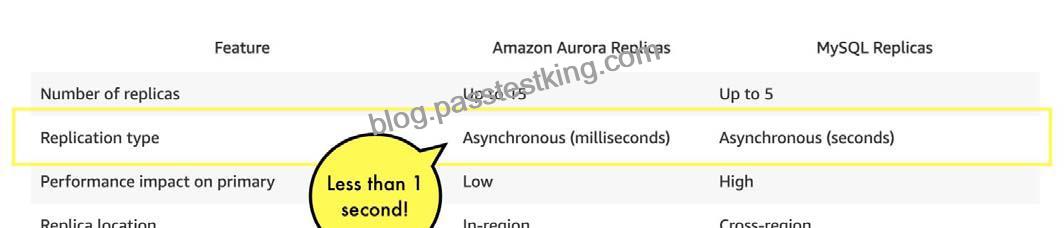

The read replication latency of less than 1 second is only possible if you would use Amazon Aurora replicas. Aurora replicas are independent endpoints in an Aurora DB cluster, best used for scaling read operations and increasing availability. You can create up to 15 replicas within an AWS Region.
Hence, the correct answer is: Migrate the existing database to Amazon Aurora and create a cross-region read replica.
The option that says: Upgrade the MySQL database engine is incorrect because upgrading the database engine wouldn’t improve the read replication latency to milliseconds. To achieve the read replication latency of less than 1-second requirement, you need to use Amazon Aurora replicas.
The option that says: Use Amazon ElastiCache to improve database performance is incorrect. Amazon ElastiCache won’t be able to improve the database performance because it is experiencing highly dynamic reads. This option would be helpful if the database frequently receives the same queries.
The option that says: Create an Amazon RDS for MySQL read replica in the secondary AWS Region is incorrect because MySQL replicas won’t provide you a read replication latency of less than 1 second.
RDS Read Replicas can only provide asynchronous replication in seconds and not in milliseconds. You have to use Amazon Aurora replicas in this scenario. References:
https://aws.amazon.com/rds/aurora/faqs/
https://docs.aws.amazon.com/AmazonRDS/latest/AuroraUserGuide/AuroraMySQL.Replication.CrossRe gion.html Amazon Aurora Overview:
https://youtu.be/iwS1h7rLNBQ
Check out this Amazon Aurora Cheat Sheet:
https://tutorialsdojo.com/amazon-aurora/